
 Just when you thought Halloween 🎃 couldn’t get any scarier – think again! Japanese knotweed is a homeowner’s property nightmare in many states and countries.
This spookily invasive plant is so damaging, and bad, that in the UK, there is a company, Knotweed Services UK (Ltd), specializing fully on it’s removal, including a payment plan and guaranteed 10-year warranty.

And, it’s not just homeowners who are terrified of this BREAK APART YOUR HOME, PROPERTY, AND DESTROY YOUR WATERWAY PLANT – some commercial businesses, like those below, have used these eradication services:

Example of some UK commercial businesses who have hired for Knotweed eradication
A Not so Spooky Tip
All this came as a tip from my mother, emailing me an article she thought I would enjoy! After looking through the business model in the UK – I thought about both how satisfying and helpful it would be to start a company like that. Judy and I would need many more lives, but, it sparked the interest here!
Coincidentally, and unknowingly, Judy had taken a few photos (below) of Japanese knotweed (Reynoutria japonica) on a recent trip to Bloomington, Indiana. Judy liked the flowers (it flowers Aug-Sept.) I told her I thought it was a nasty weed. Huh?! Turns out this seriously invasive plant is native to Japan, China, parts of Korea and Taiwan. Thanks mom for an early Halloween gift giving me the enthusiasm to look into Japanese knotweed!

Knotweed – Reynoutria japonica or Reynoutria x bohemica. Update: Looks like this may be Bohemian Knotweed. Bloomington, Indiana. Creek trail
Flowers: Typically blooming between late summer and early autumn, Japanese knotweed flowers are creamy white and form clusters of up 4 inches long. Dying back around October, the flowers leave behind hollow stems throughout the winter months.
Size: 7-9 feet tall.
Rhizome: Outside is dark brown, inside is orange/yellow. Rhizome can grow 10 feet deep and spread 6.5 to 23 feet wide, depending on soil and weather conditions. The rhizome diameter is approximately 8 inches.
How to ID: Creamy white flowers, bamboo-like hollow stems and shovel-shaped green leaves. This plant is deciduous so dies back and takes on different forms over the seasons.
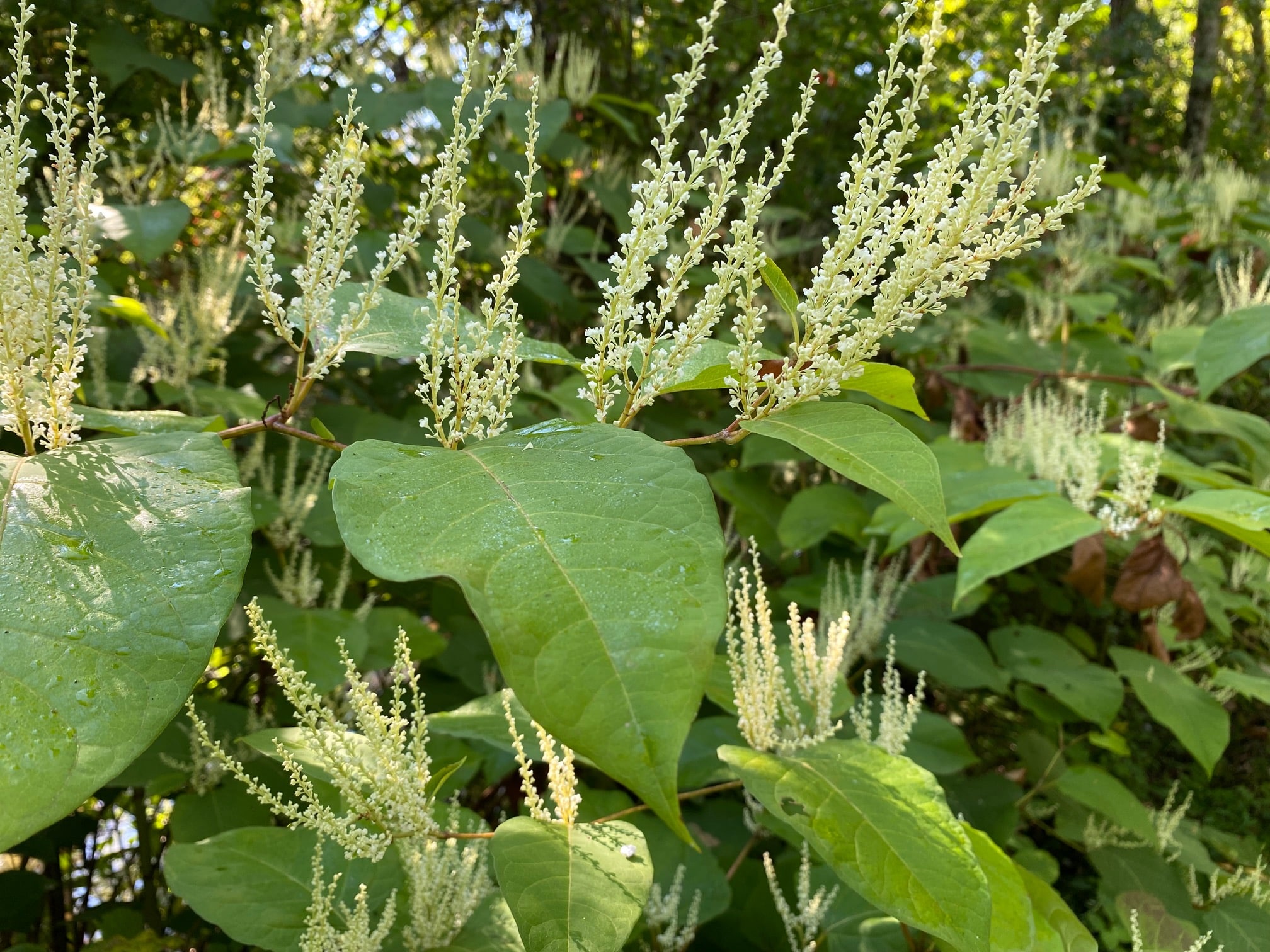
Japanese knotweed: Like most invasive species it is detrimental to its surrounding environment. Although it appear self-contained at first glance, it’s an ever-expanding issue
How and Where Does it Spread?
Much like spreading bamboo (not well behaved clumping bamboo) Japanese knotweed grows by vigorous underground horizontals rhizomes. How it spreads and infests areas typically is through dispersal of its rhizome fragments, stems and crowns. An entire plant can grow from a rhizome fragment as small as 0.393701 inches.
Growth of new stands, like photos above, block sunlight for native plants and since knotweed grows very quickly (almost 4 inches per day in summer) it consumes abundant amounts of minerals and nutrients from the soil.
In California, Japanese knotweed is moderately invasive as you can see with the California Invasive Plant Council. Here’s what they had to say:
Japanese knotweed grows vigorously and create dense colonies that exclude other vegetation. Established colonies are extremely difficult to eradicate. It inhabits disturbed moist sites, roadsides, riparian and wetland areas. Plants typically grow in open, sunny areas on moist soils in cool temperate climates. There is very little of this species in California, but it is spreading rapidly in the Northwest and has been a major problem in the southern and northern US, as well as Europe.
Here’s what Acadia National Park Service in Maine had to say about this spooky plant:
Of all the invasive plant species at Acadia National Park, Japanese Knotweed may be the most unique. Imagine a plant that can burst through pavement or sneak in through foundation cracks in your house! Their invasions tend to be sudden and aggressive, making them successful almost globally.
- Is it invasive in your state? Have a look at the Invasive Plant Atlas.
Also, take a look at: Knotweed History and Ecology in North America. This includes a deeper understanding and is useful for identification purposes as well as illustrates the various knotweeds. These are Japanese, Giant and Bohemian knotweed.
Happy Halloween!
Nicole
