
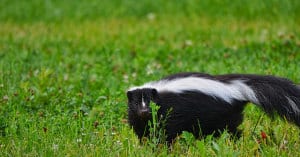
 Word in the garden is that skunks are doing more than just drive by’s: they’re wreaking havoc! With the ongoing drought, a moist, luscious garden offers a bounty of “skunk food.” You’ll find circular holes in your lawn when they dig for grubs and other insects, and there be may other items missing – fruit, vegetables, cat food. If you suspect that this is an issue in your garden (usually evident by that unmistakable, lingering odor), there are several things you can do!
Remove / Block Any Potential Skunk Dens
First, take a look for any areas where these critter may be nesting, such as under a deck or in a  garden shed. Do you notice anything in your yard that could be a potential den? Some examples are a wood or rock pile; an opening under a wooden deck or a porch. If so, close up any gaps by repairing rotted wood or covering over openings with chicken wire. With wood or rock piles, you may want to either remove them altogether, or else try tightly stacking and/or covering the piles. I knew someone who had a large, dilapidated wooden structure in the back corner of her garden and, no surprise, also had a really bad skunk problem. She wasn’t using the structure for anything so had it removed and voila, end of the skunk problem.
What Do Skunks Eat?
According to Wikipedia, “skunks are omnivorous, eating both plant and animal material and changing their diets as the seasons change. They eat insects and larvae, earthworms, grubs, small rodents, lizards, salamanders, frogs, snakes, birds, moles and eggs. They also commonly eat berries, roots, leaves, grasses, fungi and nuts.
 In settled areas, skunks also seek garbage left by humans. Less often, skunks may be found acting as scavengers, eating bird and rodent carcasses left by cats or other animals. Pet owners, particularly those of cats, may experience a skunk finding its way into a garage or basement where pet food is kept. Skunks commonly dig holes in lawns in search of grubs and worms.”
What you can do. Make sure there are no obvious food sources for the little guys such as open compost or other garbage (tight fitting lids are a must). If they are helping themselves to the veggies in the garden, a low fence should keep them out since skunks are not good climbers. If you’re feeding your pet outdoors, don’t leave food unattended. If pet food is stored outside, make sure it is in a closed, skunk proof, container. And if skunks are destroying your lawn, you can start by lowering the water. When the ground dries a little, the grubs will move deeper, and your lawn will become less of a skunk attractant.
Time to Send Your Resident Skunks Packing
Once you’ve removed what is attracting the skunks, it’s time to employ deterrents. One trick is to add some unfavorable smells to your garden. Yes, ironically there are a lot of smells they don’t like, so spraying the lawn with castor oil and dish soap will help keep them away. Another trick is to place strong smelling soaps around the garden. Additional smells skunks abhor are: citrus, ammonia, mothballs and predator’s urine (you can buy pellets of fox and coyote urine at your local hardware store, although the Humane Society considers its use inhumane).
 Another hindrance to nocturnal skunk parties are outdoor motion lights. The flash of bright, unexpected light will scare them away. Unfortunately this is not a great option if your bedroom also faces the yard. Flashing bright lights may also scare you or disrupt the evening’s rest so in this case you may want to use a light that stays on all the time. You can also boost your ‘skunk be gone’ campaign with a motion activated sprinkler and a radio, set to talk radio, close to any location you think might be a den. Mild harassment for a few days is a good way to suggest they find a new address.
As a final resort, if your skunk friends just won’t leave, you may consider setting a trap. This option is probably the least desirable, since, once trapped, how do you transport the critter to release it further away without having to later sell your vehicle?? Your best bet is to remove anything that is attracting skunks to your garden while adding in a combination of deterrents.
Skunked
If you or your pet does have the misfortune of a direct skunk encounter, forget the tomato juice! There are some good commercial products such as Nature’s Miracle Skunk Odor Remover, but that’s not much help if you don’t have any on hand. Don’t despair, you can make an effective odor neutralizing solution with some common household items. Mix together:
1 quart of 3 percent hydrogen peroxide
1/4 cup baking soda
1 teaspoon liquid soap (laundry or dishwashing soap)
Use rubber gloves to apply. Leave it on for five minutes and rinse. Repeat if the smell is still strong. Note: Do not store this mixture. Also, don’t forget to brush your pet’s teeth (not with this mixture), since they were probably sprayed in the face and got a mouthful. Skunk-sprayed collars may have to be thrown away.
*We’d love to hear from you about any home remedies or combination of solutions that worked well to get rid of your skunk problem.
Happy ‘Skunk Free’ Gardening,
Judy
