
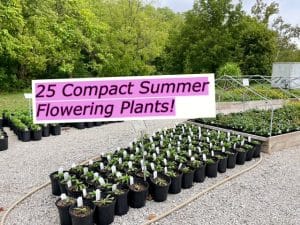
 When fear of frost is over it’s time to jump on the garden bandwagon! Flowers for color, flowers for pollinators. All ideas are on the table, from flowering trees and shrubs, to flowering perennials and annuals.
I have a few flower oriented posts under ‘Midwest Gardens’ worth checking out. I recommend this post: Spring flowering trees and shrubs as a compliment to this one if you want to chart ideas for seasonal bloom.
For the purposes of this post, the flowering plants listed here are summer bloomers. You can’t cookie cutter the idea though. No exact bloom dates apply only ranges. So any complaints, tell it to your plants, not me! Anyway, if you want to indulge, or refresh your memory, here are TWENTY FIVE SUMMER FLOWERING PLANTS that grow beautifully in Bloomington, Indiana’s zone 6 when suitably planted. Enjoy!
1. Buddleia ‘Pugster Periwinkle’

Buddleia ‘Pugster Periwinkle’
Buddleia ‘Pugster Periwinkle’ (AKA – Pugster Periwinkle Butterfly Bush) Buddleia PUGSTER is a compact series of butterfly bush bred by Proven Winners. This series features full-size, fragrant flowers on compact plants. Pugster series includes a variety of colors like white, periwinkle, amethyst, blue and pink. I found a periwinkle and a white flowering one at Bloomington Valley Nursery this July. Bloom time: summer to fall. Attracts: bees, butterflies and hummingbirds. Family: Scrophulariaceae (Figwart family). Water: average. Soil: well drained soil a must. Habit: dwarf, mounded + compact. Maintenance: low maintenance; light pruning in spring. Resists: deer and rabbits. Exposure: full sun. Size: 2′ tall x 2′ -3′ wide. Zones: 5-9.
2. Eryngium yuccifolium

Eryngium yuccifolium –
Eryngium yuccifolium (AKA – Rattlesnake Master) This eryngium with blue-green sword-like foliage looks more like a yucca, and so, the species name “yuccifolium.” Flowers: greenish white flower heads shaped like small globes flowers stalks 5-6′ tall. Water: dry to medium with an emphasis on fast draining soil to prevent winter rot which can kill plant. Origin: USA. Attracts: Good pollinator plant; attracts butterflies, bees… Family: Apiaceae (Carrot family). Habit: clump-forming with upright growth. Exposure: full sun. Bloom time: June – September. Tolerates: dry, rocky, shallow + clay soil. A good plant for erosion control as it forms a strong tap root. Size: 4-5′ tall x 2-3′ wide. Zone: 3-8.
3. Asclepias tuberosa

Asclepias tuberosa
Asclepias tuberosa (AKA- Milkweed, Butterfly Weed) This perennial milkweed possesses a mounding, compact habit with fiery-orange flowers that are add pop. Good news is that deer and rabbits tend to ignore the flowers while the monarch butterflies (as caterpillars) indulge. Note: milkweed is an important host plant for monarch butterflies as it is the only food source for caterpillars. Origin: eastern North America. Tolerates: dry, rocky, lean soils. Bloom time: spring- summer. Flowers: flat-topped clusters of vivid, star-shaped orange, yellow, or red flowers. Water: dry to medium with an emphasis on fast draining soil to prevent winter rot which can kill plant. Resists: deer and rabbits. Family: Apocynaceae (Milkweed or Dogbane family). Exposure: sun to part shade. Uses: Good cut flower. Size: 2′ tall x 1.5″ to 2′ wide. Zone: 3-9.
4. Hemerocallis fulva

Hemerocallis fulva
Hemerocallis fulva (AKA – Orange Daylily) Hemerocallis fulva, like all the daylilies, is a low maintenance, grass-like, bulbous, perennial with showy flowers that last one day, and are replaced with others. Flowers on this daylily are 6 petaled trumpet shaped that add a bright orangish showy pop to the garden for a good chunk of time. Bloom time: mid to late summer. Water: average. Exposure: full sun/part shade. Water: medium. Origin: Asia. Maintain: to encourage rebloom and to tidy plant remove spent flowers and seedheads. You can prune the flower stem (scape) to the base when all flowers are finished. Attracts: butterflies and hummingbirds Tolerates: rabbit, clay soil and drought. Note: this daylily is a good colonizer and can displace native plants so keep in check. Family: Asphodelaceae (Aloe family.) Resists: NOT deer resistant. Size: 2-2.5′ tall x 2-2.5 wide. Zone: 3-9.
–
5. Allium ‘Millenium’

Allium ‘Millenium’
Allium ‘Millenium’ (AKA- Ornamental Onion) – Allium ‘Millenium’ is a low maintenance, clump forming perennial with 2” rose-purple globe-shaped flowers appearing on strong stems just above the onion-scented foliage. As you can see, glossy, grass-like foliage is dark green and forms a tidy, dense mound; when crushed the foliage smells like onion. Attracts: butterflies and honeybees. Resists: deer, rabbit and voles. Uses: Exposure: full sun. Water: low; drought tolerant once established. Family: Amaryllidacea (Onion or Amaryllis family). Habit: upright, clumping. Flowers: purple, globe shaped; long lasting to 4 weeks. Bloom time: July – August. Size: 2-2.5′ tall x 2-2.5 wide. Zone: 4-9.
6. Summerific ‘Holy Grail’ Hibiscus Hybrid

Summerific ‘Holy Grail’ Hibiscus Hybrid
Summerific ‘Holy Grail’ Hibiscus (AKA – Dinnerplate Hibiscus, Hardy Hibiscus) This is a woody based herbaceous perennial featuring near-black foliage. Flowers: dinnerplate size 8-to-9-inch deep red flowers. Exposure: full sun best. Water: average to moist. Attracts: hummingbirds, butterflies and bees. Soil: not to wet like heavy clay or too dry like pure sand- a nice loamy soil is best. Resists: deer. Bloom time: mid-summer to early fall. Family: Malvaceae (Mallow family). Size: 4 -4.5′ tall x 4.5 -5′ wide. Zones: 4-9.
Keeping these plants watered will result in larger flowers and lush foliage. Deadheading will improve the appearance of the plant, but is not necessary for continued bloom. It is best to plant Rose Mallow Hibiscus in the garden before the heat of the summer arrives, and should be heavily mulched the first winter. In spring, cut back any remaining stems before new growth appears. Do not trim back in fall. A strong pair of loppers or a saw will be necessary to cut this plant back. Be advised that hardy Hibiscus is always one of the last perennials to emerge in spring. Be patient, even if you think this hardy hibiscus is dead, it most likely isn’t. Its vigorous growth rate more than makes up for this late start, however. Japanese beetles find these Summerific Holy Grail Hibiscus plants especially delicious. ~ Source: Proven Winners
7. Verbena bonariensis ‘Lollipop’

Verbena bonariensis ‘Lollipop’
Verbena bonariensis ‘Lollipop’ (AKA – Dwarf Tall Verbena) Verbena is a large genus of approximately 250 species of largely annual and perennial herbs. Verbena ‘Lollipop’ is a compact variety that produces airy clusters of purple flowers that sweep above a rounded mound of foliage. With well drained soil, this compact perennial is easy, low maintenance and pest resistant. Water: low to moderate; drought tolerant once established. Soil: well drained soil a must! Attracts: butterflies, bees and hummingbirds. Companion with: grasses, salvias, yarrow, echinacea, cosmos. Family: Verbenaceae (Verbena family.) Bloom time: spring to fall. Exposure: full sun. Resists: deer and rabbits. Note: This perennial may not survive a cold Bloomington winter. Let this plant go to seed and treat it like a reseeding annual. Size: 1.5-2.5′ tall x 2-3′ wide. Zone: 7-10.
8. Phlox paniculata

Phlox paniculata, July 2026
Phlox paniculata (AKA – Garden Phlox) This photo shows a cultivar of Phlox paniculata at the Trinity Episcopal Church garden in Bloomington. Phlox are known to be prone to powdery mildew so make sure you have the right conditions to grow them, and, that you choose ones that are mildew resistant. Several mildew resistant varieties include: David, Jeana and Glamour Girl. Exposure: full sun to part sun. Water: moist; however, avoid overhead watering due to powdery mildew. Bloom time: summer. Flower colors: lavender, lilac, pink, purple, salmon and white. Family: Polemoniaceae (Jacob’s-ladder or Phlox family.) Attracts: good pollinator plant; attracts butterflies, bees, hummingbirds, beneficial insects and songbirds. Resistance: somewhat deer and rabbit resistant. Uses: cut flowers, fragrant flowers Origin: North America. Tolerances: Size: 2-4′ tall x 2-3′ wide. Zone: 4-8.
9. Pink Astilbe

Pink Astilbe – June 23, 2023 Bloomington, IN
Pink Astilbe (AKA- False Goat Beard, False Spirea) There are 18 species of astilbe and hundreds of cultivars meaning you can choose from beaucop flower colors, sizes, and bloom times. The pink astilbe grouping here is located in a shady spot on the IU campus beneath a Japanese maple. Astilbes are reliable summer bloomers and perfect for the shade garden. Companion with: Heucheras (Coral Bells), Hosta, Dicentra (Bleeding Hearts), Ferns, Azaleas, Rhododendron, Ajuga (Bugleweed) and Alchemilla (Lady’s Mantle). Flowers: feathery plume-like flower heads. Family: Saxifragaceae (Saxifrage family). Water: moist. Exposure: part to full shade. Size: depends on variety, dwarf plants to large ones: 8″- 4′ tall. Zone: 3-9.
10. Stachys monieri ‘Hummelo’

Stachys monieri ‘Hummelo’
Stachys ‘Hummelo’ (AKA – Betony) This is an easy to grow, polite, clump forming perennial. Companion plants: Echinacea (Coneflower), Nepeta (Catmint), Sedum, Alchemilla (Lady’s Mantle) and Salvia (Sage). Exposure: full sun to part shade. Flowers: dense, bottle-brush spikes of rose-lavender, violet, or magenta flowers. Bloom time: early to mid-summer. Resists: deer and rabbits. Attracts: butterflies, hummingbirds, bees. Family: Lamiaceae (Mint family.) Uses: cut flower, border plant, mass planting, container. Water: average; established plants are pretty drought tolerant. Size: 18-24″ tall x 18-24 “wide. Zone: 4-8.
11. Leucanthemum superbum

Leucanthemum x superbum
Leucanthemum x superbum (AKA- Shasta Daisy) Shasta daisy was first discovered in Mt. Shasta, California. Since that time plant breeders have played around to cultivate almost 100 varieties. Uses: good cut flower. Exposure: full sun. Water: average water; moderately drought tolerant once established. Attracts: bees, butterflies, beneficial insects, Resists: deer and rabbits. Soil: good drainage a must. Family: Asteraceae (Daisy or Sunflower family.) Habit: upright, clump-forming with mounded growth habit. Bloom time: June -August. Flowers: classic white daisy flowers with bright yellow centers. Leucanthemum ‘Becky’ is a popular choice and a tough Shasta daisy. This variety grows 3-4′ tall x 2-3′ wide and flowers are 3″ single, white blooms with yellow centers on a lush mound of coarse, leathery, green foliage. Size: 2-3′ tall x 1-2′ wide; exact size depends on specific cultivar. Zone: 5-9.
12. Achillea filipendulina

Achillea filipendulina
Achillea filipendulina (AKA – Fern-Leaf Yarrow, Gold Yarrow) The yarrow in the photo might be ‘Coronation Gold’ or ‘Cloth of Gold.’ The species features flat-topped clusters of bright golden-yellow flowers, deeply dissected fern-like aromatic leaves. Exposure: full sun. Water: low to moderate; drought tolerant when established. Soil: good drainage a must. Attracts: bees, butterflies, beneficial insects, songbirds. Bloom time: June – September. Companion plants: ornamental grasses, many of those listed here that are sun and low water loving. Flowers: striking, flat-topped golden-yellow flower clusters. Habit: upright, stiffly erect clump forming. Resists: deer and rabbits. Size: 3-5′ tall x 2-3′ wide. Zone: 3-8.
13. Calamagrostis x acutiflora ‘Karl Foerster’

Calamagrostis ‘Karl Foerster’
Calamagrostis x acutiflora ‘Karl Foerster’ (AKA- Feather Reed Grass) This popular, well behaved grass is lovely in the small garden for its’ compact size which is slim and rigid verticality. Uses: vertical accent, privacy screen, mass planting, specimen. Exposure: full sun to part shade. Water: handles high, medium and low water once established. Attracts: birds. Resists: deer and rabbit, resistant and ok with clay soil. Bloom time: begin in June. Flowers: enjoy seasonal progression as flower heads start off pinkish purple then toasty brown, fading to a buff color a couple months later. Spikes rise 5-6 feet above base foliage and on top sit feathery plume flower heads. These can add architectural interest into winter. Family: Poaceae (Grass family.) Maintain: cut the stalks back to 6 inches in late winter, or early spring before new growth emerges. Size: base foliage is 2′ tall x 2-3′ wide. Zone: 4-9.
14. Rudbeckia hirta

Rudbeckia hirta
Rudbeckia hirta (AKA – Black-Eyed Susan, Yellow Coneflower) Rudbeckia is one of the easiest perennials to grow and nothing makes us happier than yellow flowering summer daisies! Black-eyed Susan is a classic summer flower and Rudbeckia hirta has many cultivars and varieties to choose from. Note: perennial Rudbeckia tends to multiply rapidly because it self sows. Bloom time: summer to fall. Uses: Good cut flower. Note: To make last longer, cut each flower 9″ so that each flower has it’s own stem. Family: Asteraceae (daisy or sunflower family.) Origin: North America. Exposure: full sun best. Water: average; drought tolerant once established. Attracts: bees and butterflies. In winter seedheads provide food source for songbirds. Size: 2-4′ tall x 1-2′ wide. Zone: 3-9.
15. Echinacea purpurea

Echinacea purpurea
Echinacea purpurea (AKA – Purple Coneflower) If you want to plant echinacea in your garden, choosing E. purpurea is an excellent choice. In fact, sticking with single flower type echinacea like E. purpurea and those listed below invites more pollinators to your planting and garden
‘White Swan’: A beautiful, honey-scented option. Flowers: bright white petals around a rich bronze-yellow cone.
‘Magnus’: A classic cultivar of the native species. Flowers: flat, horizontal pink-purple petals rather than the typical downturned look, creating an excellent landing pad for butterflies.
‘Ruby Star’: Similar to ‘Magnus’, but with more intense carmine-red flowers on sturdy stems.
‘Bravado’: Popular for its massive 4-to-5-inch wide pinkish-purple flower heads and strong fragrance, making it a beacon for local bees.
Echinacea pallida: This echinacea blooms earlier in summer than E. purpurea. Flowers: elegant drooping pale pink petals. Highly attractive to native pollinators.
Echinacea info: Water: moist upon planting; drought tolerant once established. Bloom time: June – September. Soil: good drainage a must. Family: Asteraceae (daisy or sunflower family.) Exposure: full sun best. Resists: new plants are susceptible to deer and rabbit browsing. Established plants tend to be fairly deer resistant. E. purpurea Size: 2-4′ tall x 1.5-2′ wide. Zone: 3-9.
16. Coreopsis verticillata

Coreopsis verticillata
Coreopsis verticillata (AKA – Threadleaf Coreopsis or Whorled Tickseed) Coreopsis verticillata is a clump forming perennial with fine needle-like leaves. 3 popular cultivars are: ‘Zagreb’ (deep golden-yellow flowers); ‘Moonbeam’ (pale lemon yellow flowers); ‘Creme Brulee’ (rich deep yellow flowers); ‘Route 66’ (bright yellow flowers with burgundy center.) Family: Asteraceae (Daisy or Sunflower family.) Water: low; drought tolerant once established. Exposure: full sun to part sun. Soil: well drained a must. Resists: deer and rabbits. Attracts: bees, butterflies and beneficial insects. Bloom time: June to September. Flowers: small and bright, yellow to golden yellow daisy-like flowers; long bloom run. Size: 2-3 ‘tall x 1.5-2.5’ wide. Zone: 3-9
17. Perovskia atriplifolia ‘Little Spire’

Perovskia atriplifolia ‘Little Spire’
Perovskia ‘Little Spire’ (AKA – Dwarf Russian Sage) Perovskia is in the mint family, and dwarf Russian sage, ‘Little Spire’ is shorter and more upright than the standard variety. Flowers: lavender-blue summer flowers, silvery-green fragrant foliage. Resists: deer and rabbits. Bloom time: July to October. Origin: Central Asia. Attracts: bees, butterflies and hummingbirds. Family: Lamiaceae (mint and sage family.) Water: dry to average; drought tolerant once established. Exposure: full sun. Soil: good drainage a must; lean soil great. Size: 18-36″ tall x 18 -30″ wide. Zone: 4-9.
18. Liatris spicata

Liatris spicata
Liatris spicata (AKA – Blazing Star) Liatris is tall and upright and provides nice vertical form with grassy leaves.
Exposure: full sun to part shade. Water: medium to moist. Bloom color: pink, purple and white. Popular varieties: 1. ‘Kobold’ – compact rosy-purple spikes 18-24″ tall, resists flopping; 2.‘ Floristan White‘ – bright white blooms 3-4′ tall; 3.’ Floristan Violet’ – long 12-15″ violet flower plumes; 2-3′ tall. Soil: good drainage a must. Resists: deer and rabbits. Attracts: butterflies, hummingbirds, songbirds, bees. Family: Asteraceae (Daisy or Sunflower family.) Bloom time: July to September. Origin: North America. Uses: good cut flower and for drying. Nice in border planted in groups. Origin: North America. Size: 3-5′ tall x 1-1.5 wide. Zone: 3-8.
19. Ratibida pinnata

Ratibida pinnata
Ratibida pinnata (AKA- Yellow Coneflower, Gray-Headed Coneflower) Ratibida is native to dry prairies and savannas and is a clump forming rhizomatic perennial. If it becomes too happy make sure to keep it in check so that it doesn’t overtake. Flowers: unique yellow (2″) drooping petals surround an upright round to oval cone. Exposure: full sun to part shade. Water: medium to medium dry. Resists: deer and rabbits. Origin: Eastern USA. Bloom time: June to August. Family: Asteraceae (Aster family.) Size: 3-5′ tall x 1.5 -2.5 width. Zone: 3-9
20. Verbena hastata

Verbena hastata
Verbena hastata (AKA -Swamp Verbena, Blue Vervain) This is a slender upright clumping perennial with stiff erect squarish stems. Root system: short rhizomatous roots. Flowers: narrow spikey panicles of small tubular blue-purple flowers which branch upwards like the arms of a candelabra. The flowers at the bottom of the spike bloom first. Bloom time: July – September. Exposure: full to part sun. Water: wet, moist, or medium-wet; low drought tolerance. Family: Verbenaceae (Verbena family.) Origin: North America. Attracts: insects, local bumblebees, birds, butterflies. Also, this verbena is a larval host plant to common Buckeye butterfly and verbena moth. Size: 2-6′ tall x 1-2.5′ wide. Zone: 3-9.
21. Heuchera spp.

Heuchera spp.
Heuchera spp. (AKA – Coral Bells) Heucheras are popular more for their vibrant multiseasonal leaf color than for their flower spikes. They come in a wide variety of leaf colors: deep purple, almost black, lime green, chartreuse, amber; and, a wide variety of leaf shapes: scalloped, heart-shaped, rounded, deeply lobed. Family: Saxifragaceae (Saxifrage family). Bloom time: late spring or summer. Flowers: delicate flower spikes 1-3′ tall. Exposure: dark leaved heucheras (like photo) can tolerate more sunlight than lighter varieties. Part shade to shade or morning sun is generally fine. Water: average; somewhat drought tolerant once established. Provide extra water during dry spells. Attracts: hummingbirds, butterflies and bees. Resists: deer and rabbits. Size: 6-18″ tall x 12 to 30″ wide. Zone: 4-7.
sc
22. Scabiosa columbaria ‘Butterfly Blue’

Scabiosa columbaria ‘Butterfly Blue’
Scabiosa columbaria ‘Butterfly Blue’ (AKA – Butterfly Blue Pincushion Flower, Pincushion Flower) This is a compact perennial perfect for front of the border or in a pot on the front porch. Water: medium to low; drought tolerant once established. Soil: good drainage a must. Exposure: full sun. Flowers: Multiple frilly blue-purple pincushion-shaped flowers. Bloom time: April to early frost. Attracts: hummingbirds, bumblebees, honeybees, butterflies. Resistant: deer and rabbit. Family: Caprifoliaceae (Honeysuckle family.) Size: 12-18″ tall x 12-18″ wide. Zone: 4-9.
23. Sedum spectabile ‘Autumn Joy’

Sedum spectabile ‘Autumn Joy’
Sedum spectabile ‘Autumn Joy’ (AKA – Autumn Joy Sedum) Here’s a fantastic succulent plant that will overwinter in Zone 6. Sedum is a tough as nails perennial that has multi-season interest but to get it to return each year lean sharp draining soils are essential. Happy in sun and heat, nice long lived perennial
Exposure: full sun. Water: low; drought tolerant. Attracts: butterflies, bees, beneficial insects especially late summer and into fall. Resists: mostly deer and rabbit resistant. Flowers: transform from (in photo) light-green flower heads that look like packed heads of broccoli to rosy-pink in fall as weather cools flowers transition to a deeper rose red. Soil: good drainage a must. Family: Crassulaceae (Stonecrop family.) Size: 18-24″ tall x 18-24″ wide. Zone: 3-9.
24. Monarda fistulosa

Monarda fistulosa
Monarda fistulosa (AKA -Purple Bee Balm or Wild Bergamot) This tough North American native perennial in the mint family is a nice choice for the small gardens. It has rich minty aromatic foliage and can be used as a tea or enjoyed by local pollinators. Exposure: full sun to part shade. Bloom time: June – September. Flowers: ragged, lavender pompoms spanning 1 to 2 inches wide. Attracts: bees, hummingbirds, butterflies. Resists: deer and rabbits. Flowers: lavender blossom and distinctively aromatic foliage. Bloom time: July to September. Water: low to average; drought tolerant once established. Origin: North America. Uses: herbal medicine with rich antiseptic oils: thymol and carvacrol. Family: Lamiaceae (Mint family.) Size: 2-4′ tall x 2-3′ wide. Zone: 3-9.
25. Physostegia virginiana ‘Pink Manners’

Physostegia virginiana ‘Pink Manners’
Physostegia virginiana ‘Pink Manners’ (AKA – Obedient Plant) This perennial has “great manners” and with short rhizomes isn’t invasive like the bad reputation following many of the wild, long rhizome invasive and spreading Physostegia virginiana. “Pink Manners” is a wonderful clump forming upright perennial. The common name, Obedient plant, is due to a unique biological quirk where individual flowers can be pushed into a new position on the stem and will stay exactly where placed. Bloom time: June to September. Flowers: snapdragon-like soft rose-pink to lavender-pink tubular flowers on strong, upright spikes. Water: average. Soil: well drained; best to have lean less fertile soil to help keep plant from flopping over. Attracts: butterflies, bees and hummingbirds. Resists: deer and rabbits. Exposure: full sun to part shade. Family: Lamiaceae (Mint family.) Size: 2-3′ tall x 18-20″ wide. Zone: 3-9.
Conclusion:
This list is partial. 25-flowering plants is just a drop in the bucket for peak summer months. But, the local plant palette typically includes popular choices that return following winter and do well in the area. The biggest challenge to survival with all of the above plants is largely related to soil and not hardiness or cold. Damp wet heavy clay soils are the kiss of death. If your perennials aren’t returning consider raised beds and amending your soil for grittier texture and fast drainage. Note that i included “Soil” for most plants, and almost every one I said “good drainage a must.” Underscore this. It’s what makes the difference between a plant that dies back to ground in winter and returns in spring; to one that dies and doesn’t return for you to enjoy. This can be hugely disappointing and expensive.
